Use our free Home Equity Calculator to estimate how much equity you have in your home and how much you may be able to borrow. By entering your property value, remaining mortgage balance, and other secured debts, you can calculate your estimated equity and loan-to-value ratio. The calculator also helps you explore potential borrowing capacity and forecast how your equity could change over time.
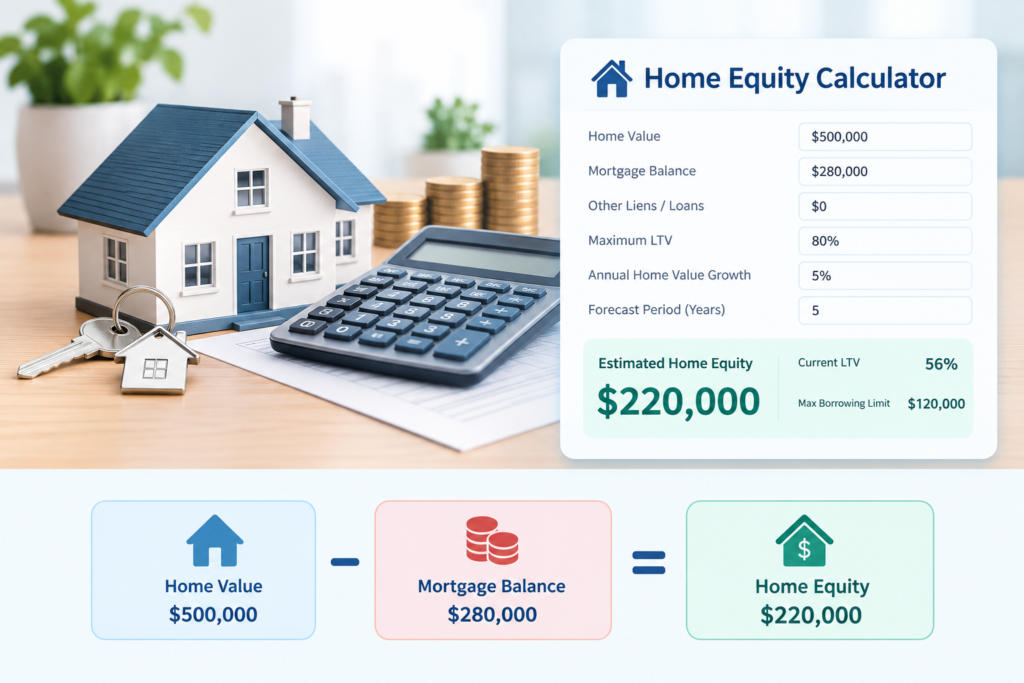
Whether you are planning home improvements, reviewing your mortgage, or considering a home equity loan, understanding your property’s equity can help you make more informed financial decisions.
What Is Home Equity?
Home equity is the difference between your home’s current estimated value and the total debt secured against it. It represents the portion of the property’s value that is not covered by those debts.
For example, if your home is worth $400,000 and your outstanding mortgage is $250,000, your estimated home equity is $150,000, assuming there are no other secured loans.
A home equity calculator makes this calculation easier by helping you compare your property’s value with your outstanding debt. However, the amount of equity you own is not necessarily the same as the amount a lender will allow you to borrow.
Home equity can increase as you repay mortgage principal or if your property value rises. Conversely, it can decrease when property values fall or you borrow additional money against your home.
How to Use the Home Equity Calculator
Our home equity calculator is designed to help you estimate your current equity and explore possible future scenarios.
Follow these steps to get started:
- Enter your home value. Begin with an estimate of your property’s current market value.
- Enter your mortgage balance. Use the outstanding principal shown on your latest mortgage statement rather than the original loan amount.
- Add other secured debts. Include any additional loans or liens secured against your property, where supported by the calculator.
- Choose a maximum loan-to-value ratio. Enter the Loan-to-Value limit you want to use when estimating potential borrowing capacity.
- Enter annual home value growth. Select an assumed growth rate to estimate how your property value might change.
- Choose the forecast period. Select how many years into the future you want to project your equity.
- Review your results. Examine your estimated equity, current Loan-to-Value, potential borrowing capacity, and future projections.
For a more accurate estimate, use up-to-date property and mortgage figures. Actual lending decisions may differ because lenders apply their own valuation methods and eligibility requirements.
How to Calculate Home Equity
The basic home equity formula is:
Home Equity = Current Home Value − Total Secured Debt
Total secured debt may include your primary mortgage, second mortgage, home equity loan, and other loans or liens secured against the property.
Example of a Home Equity Calculation
Suppose your property has the following financial details:
- Current home value: $400,000
- Remaining mortgage balance: $250,000
- Other secured debts: $0
The calculation is:
$400,000 − $250,000 = $150,000
Your estimated home equity is $150,000.
This means the difference between your home’s estimated value and its secured debt is $150,000. Nevertheless, this figure does not account for potential selling costs, fees, or other expenses that could affect the amount you receive if you sell your property.
You can use the home equity calculator to repeat this calculation with your own figures and compare different scenarios.
Understanding Your Home Equity Percentage
Your home equity percentage shows how much of your property’s value is represented by your equity.
The formula is:
Home Equity Percentage = (Home Equity ÷ Home Value) × 100
Using the previous example:
($150,000 ÷ $400,000) × 100 = 37.5%
Therefore, your estimated equity represents 37.5% of your home’s value.
The remaining 62.5% corresponds to the mortgage balance in this example, assuming no other secured debt exists. As you pay down your principal or your home value increases, this percentage may rise.
Loan-to-Value Ratio Explained
Loan-to-value ratio, or Loan-to-Value, compares your mortgage balance with your property’s estimated value. Lenders often use this ratio when reviewing mortgage refinancing and home equity borrowing applications.
The formula is:
Loan-to-Value = (Mortgage Balance ÷ Home Value) × 100
For example, if your home is worth $400,000 and your mortgage balance is $250,000:
($250,000 ÷ $400,000) × 100 = 62.5%
Your mortgage Loan-to-Value is 62.5%.
When multiple loans or liens are secured against your home, combined loan-to-value ratio may provide a more complete picture because it considers total secured debt.
Although a lower Loan-to-Value may indicate more equity relative to the property’s value, it does not guarantee loan approval. Lenders may also review your income, credit history, existing debts, and ability to repay.
How Much Equity Can You Borrow Against Your Home?
The equity you own and the amount you can borrow are two different things.
A lender may allow you to borrow only up to a certain percentage of your property’s value. That limit depends on the lender, the loan product, your financial circumstances, and the property’s valuation.
For a simplified estimate, use the following formulas:
Maximum Total Secured Debt = Home Value × Maximum Loan-to-Value
Potential Additional Borrowing = Maximum Total Secured Debt − Existing Secured Debt
For example, assume your home is worth $400,000, your existing secured debt is $250,000, and you select a maximum Loan-to-Value of 80%.
Maximum total secured debt:
$400,000 × 80% = $320,000
Potential additional borrowing:
$320,000 − $250,000 = $70,000
Under these assumptions, the estimated additional borrowing capacity is $70,000.
The home equity calculator can help you explore this type of scenario. However, the result is not a loan offer or approval. A lender may approve a smaller amount or decline an application based on its lending criteria, property valuation, fees, income requirements, or credit assessment.
How Property Value Changes Affect Your Equity
Your home equity can change over time as your property value and outstanding debt change.
For example, if your home’s value increases while your mortgage principal decreases, your equity may grow. On the other hand, a drop in property value can reduce your equity even if your mortgage balance stays the same.
The forecast feature in our home equity calculator lets you explore possible future outcomes by entering an assumed annual home value growth rate and a forecast period.
You can compare different growth assumptions to understand how sensitive your estimated equity may be to changes in property values. Nevertheless, property markets fluctuate, so the forecast should be treated as a planning estimate rather than a prediction of future market prices.
Factors That Affect Home Equity
Several factors can influence the equity you have in your property.
- Property value: A higher market value can increase equity, while a lower value can reduce it.
- Mortgage principal: Repaying principal generally increases equity when other factors remain unchanged.
- Additional borrowing: New loans secured against your home increase the debt deducted from its value.
- Other liens: Existing secured obligations may reduce the equity available after debts are considered.
- Property market conditions: Local demand and wider economic conditions can influence home values.
- Selling expenses: Agent fees, closing costs, and other charges can reduce the proceeds you receive when selling.
By reviewing these factors, you can better understand changes in your equity estimate and use a home equity calculator to compare alternative scenarios.
Home Equity Loan vs. Home Equity Lines of Credit
Home equity loans and home equity lines of credit are two common borrowing options that use your property as collateral. Although both may allow you to borrow against your equity, they work differently.
Home Equity Loan
A home equity loan typically provides a lump sum that you repay according to the loan agreement. Depending on the product, it may have a fixed or adjustable interest rate.
This option may suit borrowers who need a specific amount and prefer a structured repayment schedule.
Home Equity Line of Credit
A Home Equity Lines of Credit generally provides a revolving credit line that allows you to borrow funds as needed, up to an approved limit. Interest rates are often variable, and payments may change depending on your balance and loan terms.
Before choosing either option, compare interest rates, fees, repayment schedules, and the effect of payments on your budget. Remember that your home serves as collateral, so failing to repay as agreed could put your property at risk.
When Should You Use a Home Equity Calculator?
A home equity calculator can be useful in several situations:
- Reviewing your financial position: Estimate how much equity you have accumulated.
- Planning home improvements: Explore your approximate equity before discussing financing options.
- Comparing borrowing scenarios: Understand how different Loan-to-Value assumptions affect potential borrowing capacity.
- Planning for the future: Explore how assumed property value changes may affect your equity.
- Preparing for a lender discussion: Organize your property value and mortgage balance figures in advance.
- Tracking changes: Recalculate your equity when your mortgage balance or estimated property value changes.
Ultimately, the calculator provides a starting point for planning. It cannot determine whether you qualify for a specific financial product.
Frequently Asked Questions
How do I calculate the equity in my home?
Subtract the total debt secured against your property from its current estimated value. For instance, a home worth $400,000 with $250,000 in secured debt has an estimated $150,000 in equity.
Is home equity the same as available equity?
No. Home equity is the difference between property value and secured debt. By contrast, available borrowing capacity depends on lender limits, eligibility requirements, fees, and your financial circumstances.
What is a good home equity percentage?
There is no single percentage that is ideal for every homeowner. Generally, a higher equity percentage means a smaller share of the property’s value is covered by debt. However, the appropriate amount depends on your financial goals and circumstances.
Does paying my mortgage increase home equity?
Yes. Paying down mortgage principal generally increases equity if the property’s value and other secured debts remain unchanged. However, mortgage payments can also include interest, taxes, and insurance, which do not all reduce the principal balance.
Can home equity decrease?
Yes. Your equity can decrease if your property value falls or you take on additional secured debt. Changes in market conditions can therefore affect your equity even when you continue making mortgage payments.
Does this calculator guarantee how much I can borrow?
No. The calculator estimates potential borrowing capacity using your inputs and assumptions. Actual loan approval depends on the lender’s valuation, credit assessment, income requirements, and other conditions.
Is a home equity loan different from a Home Equity Lines of Credit?
Yes. A home equity loan typically provides a lump sum, while a Home Equity Lines of Credit generally provides access to a revolving credit line. Their interest rates, fees, repayment structures, and terms can differ.
Explore More Financial Calculators
WorldInfoAI offers a range of online calculators to help you understand housing expenses and other financial decisions.
- Mortgage Calculator: Estimate mortgage payments and interest costs.
- Loan Calculator: Calculate loan payments and total interest.
- Closing Cost Calculator: Estimate costs associated with buying a home.
- Property Tax Calculator: Estimate annual property taxes.
- Investment Calculator: Explore potential investment growth.
- Debt Payoff Calculator: Estimate repayment timelines and interest costs.
These tools cover different aspects of financial planning. Use the calculators that fit your needs to compare costs and explore possible scenarios.
Disclaimer
This Home Equity Calculator provides estimates for general informational and educational purposes only. Results depend on the figures and assumptions entered and may not reflect lender valuations, eligibility requirements, fees, or final loan terms.
Furthermore, borrowing against your home creates a financial obligation secured by your property. If you cannot repay the debt as agreed, you may risk foreclosure. Consider consulting a qualified financial professional or lender before making a borrowing decision.